A Banker total of six is only the beginning of a Lucky 6 check. Banker must also win, and the table may pay a two card winning six differently from a three card winning six. We separate the main Banker wager from the optional side bet, because a reduced ordinary Banker payment and a winning Lucky 6 payment can occur on the same round without contradicting each other.
Summary
- The usual side bet condition concerns Banker winning on six.
- A tied six fails a winning condition.
- Two card and three card paytables may differ.
- The ordinary Banker settlement is a separate rule.
Follow the money on one Banker six
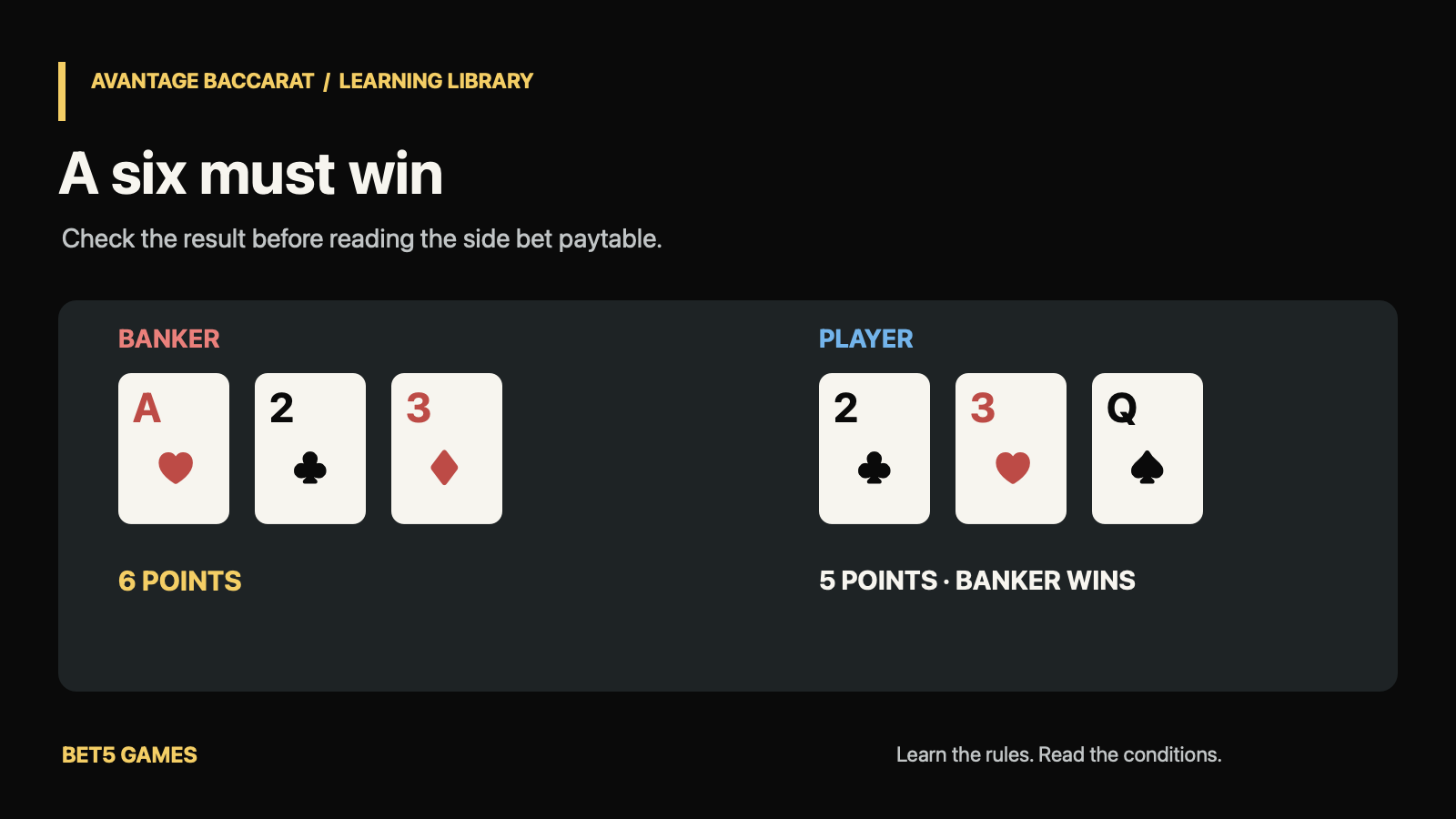
Consider Banker ace, two and three, totalling six, against Player two, three and queen, totalling five. Banker wins. Player’s initial five draws the queen; Banker’s initial three draws against that zero value third card. This is a legal illustrative three card winning six, rather than a combination assembled without regard to the drawing rules.
There may be two separate wagers to settle: the ordinary Banker chip and an optional Lucky 6 chip. A commission free table can apply a special ordinary Banker payment on a winning six. Its Lucky 6 side bet then uses its own qualifying event and paytable. The correct account credit adds the settlements of the wagers actually accepted.
| Wager record | Question to answer | Rule source |
|---|---|---|
| Main Banker stake | How does this game pay a Banker win on six? | The ordinary Banker settlement rules |
| Lucky 6 side stake | Does this winning six meet the side bet condition? | The side bet’s own qualifying event |
| Card count | Does two versus three cards change the return? | The relevant paytable row |
| Combined credit | What is each stake’s separate returned amount? | Both accepted wager records together |
An illustrative credit calculation
For a purely illustrative calculation, suppose the main Banker stake is ten units and the table pays half a unit of profit per unit on this winning six. Its credit is fifteen: ten units returned plus five profit. Now suppose a separate two unit side stake qualifies at an assumed twelve to one profit payout. Its credit is twenty six: the two unit stake plus twenty four profit. These are stated assumptions for the example, not a quotation of a current table’s paytable.
Together the two credits are forty one units against twelve units originally placed, producing twenty nine units net profit. Calling all forty one units winnings would count returned stakes as profit. Conversely, inspecting only the fifteen unit main credit would ignore the separate side wager. If your table uses another return, substitute that return before calculating. The method remains to identify each accepted stake, calculate its own credit and then reconcile the combined change. A single combined balance notification can conceal that breakdown, which is why the wager history is the better starting record.
The same six can win, tie or lose
| Banker total | Player total | Main result | Winning six test |
|---|---|---|---|
| Six | Five | Banker wins | Proceed to card count and paytable |
| Six | Six | Tie | The required Banker win is absent |
| Six | Seven | Banker loses | The total alone does not qualify |
Card count is a second distinction
A two card six and a three card six have the same point total. They need not receive the same side bet return. Read whether the game covers all winning sixes, distinguishes them or restricts its condition further. A familiar Lucky 6 or Super 6 name cannot establish that two operators use identical definitions.
- Check the winning condition before discussing the payout. If Banker tied or lost, a table that requires a winning six has no qualifying event to price.
- Read the two card and three card rows separately, including any note about whether the quoted amount includes the original stake.
- Keep the accepted main stake and side stake separate in your record. One displayed balance change can combine several credits and debits.
- Confirm any accompanying main wager requirement before assuming a side chip was accepted.
- Count every wager toward the session limit. Two chips tied to one Banker hand still expose more money than one chip alone.
What this example does not establish
The example does not imply that all baccarat games offer Lucky 6, or that a winning six always pays one fixed amount. The Either Pair guide illustrates another separate condition, while Panda 8 uses a different side and total. Compare each wager’s actual requirements rather than treating side bets as interchangeable bonus labels.
Our Avantage Baccarat format uses multiple player versus bank matchups and additional betting windows. This glossary description does not promise Lucky 6 as an available wager in that format. A player who moves between games should learn the new conditions before transferring a settlement assumption from a conventional table.
- A natural is an initial eight or nine; an initial six is not a natural.
- A pair can coexist with a six, but matching ranks are not the usual Lucky 6 qualifying test.
- A screenshot should show both completed hands and the accepted side wager when you ask about a credit.
- In a combined credit, separate returned stakes from actual profit before comparing the amount with an advertised payout.
- Actual qualifying terms take priority over any assumed figures in this example.
FAQs about Lucky 6
Why is the main Banker credit smaller on some tables?
Certain commission free games use a reduced payment for a winning Banker six. That is a main wager rule, not proof that a separate Lucky 6 wager was placed.
Can a two card six become a three card six?
Only the prescribed drawing rules determine whether another card is dealt. You cannot choose a third card merely to reach a paytable category.
What does “for one” change in a payout?
It generally describes a total return including the original stake, whereas “to one” normally describes winnings plus the returned stake. Check the operator’s definition before comparing amounts.
How should I compare two Lucky 6 tables?
Compare the exact event, card count categories, stake requirements and credited return. Similar names are insufficient evidence that the products settle identically.