A baccarat sure win formula cannot guarantee a profit from ordinary wagers. Changing the stake after a loss does not force the next hand to produce the result the formula needs. We test the claim by writing out the required stakes, checking the return and asking what happens when the money or table limit runs out. This reveals the missing assumptions more clearly than a screenshot of a successful recovery.
Summary
- A betting progression changes financial exposure, not the dealt result.
- A doubling plan needs rapidly increasing stakes after losses.
- Commission or reduced returns can invalidate a simplified recovery calculation.
- Win frequency is incomplete without the size of losing sessions.
- Extra information or betting opportunities never amount to a guaranteed profit.
Write down the promise before testing the method
“Sure win” can conceal several different claims. It might mean winning the next hand, recovering every earlier loss, ending each session ahead or showing a high percentage of winning sessions. Those are different propositions. A seller who switches between them whenever an example loses has not supplied one testable method.
- Ask what counts as a completed session and whether a losing balance can keep the session open indefinitely.
- Identify the required starting funds and the maximum permitted stake.
- Record the exact wager and payout assumptions.
- Include failed attempts without restarting the history.
A useful test also states when the method stops. Without a stopping condition, a claim can postpone recognition of a loss by describing it as merely unfinished. That wording does not increase the money available, remove a table limit or settle an outstanding debit. It only changes how the result is presented.
The doubling ladder exposes the funding requirement
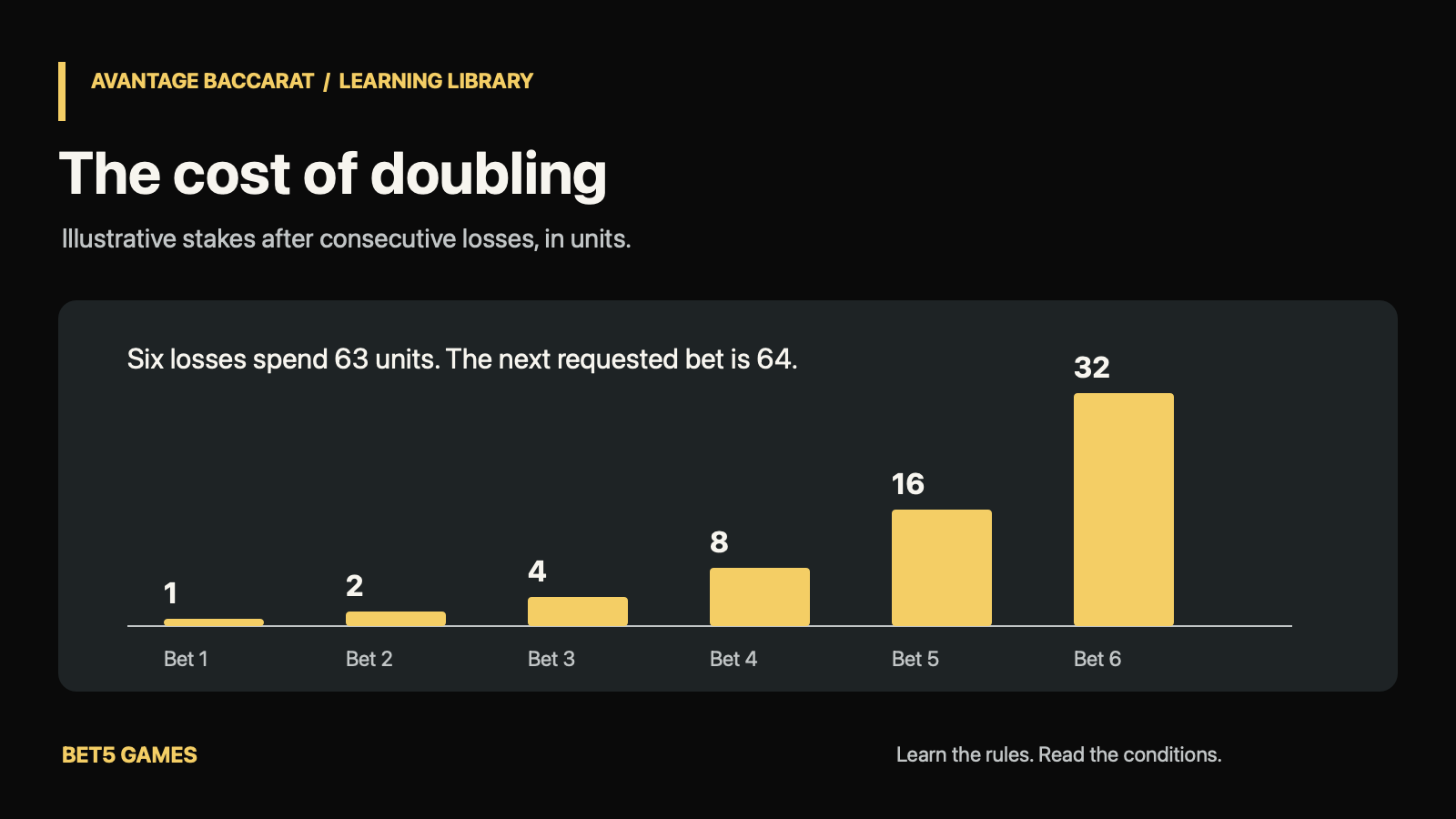
Consider an illustrative one unit starting stake, doubled after each losing decisive wager. Assume initially that a win pays one unit of profit per unit staked and that ties, if present, return the stake without changing the progression. This simplified model is deliberately generous: the actual table may impose commission or another return.
| Wager number | Stake requested | Losses accumulated if it loses | Next requested stake |
|---|---|---|---|
| One | One unit | One unit | Two units |
| Two | Two units | Three units | Four units |
| Three | Four units | Seven units | Eight units |
| Four | Eight units | Fifteen units | Sixteen units |
| Five | Sixteen units | Thirty one units | Thirty two units |
| Six | Thirty two units | Sixty three units | Sixty four units |
| Seven | Sixty four units | One hundred twenty seven units | One hundred twenty eight units |
After six losses, the plan has already spent sixty three units and now asks for a sixty four unit wager. A person who began with one hundred units has thirty seven remaining, so the prescribed next stake is unaffordable. The method cannot finish its advertised recovery sequence merely because it has a name or because smaller sequences recovered earlier.
A table maximum creates another stopping point
Even a larger budget does not guarantee permission to place the next prescribed amount. A table maximum can prevent the next double. Changing tables or accounts introduces additional practical assumptions and still does not establish a winning result. A progression that requires unlimited stakes and unlimited funding is not a practical guarantee for a finite session.
- Calculate cumulative losses, not only the largest chip. You need money for all the preceding failed wagers as well as the next request.
- Compare the next requested stake with both your remaining session budget and the actual table maximum.
- Stop the test at the first point where the prescribed action cannot occur. Do not pretend that a smaller substitute wager is the original method.
- Treat any restart after a failed sequence as a new attempt with the earlier loss still included.
- Distinguish a tie that returns a stake from a losing wager; the model must state how it handles every possible settlement.
The payout can break the arithmetic before the budget does
Suppose five losing stakes have cost thirty one units. The next prescribed wager is thirty two. In the simplified even money model, a winning thirty two unit wager produces thirty two units of profit, covering the earlier losses and leaving one unit. But a winning Banker wager subject to five per cent commission produces only thirty point four units of profit.
| Illustrative winning return | Profit on thirty two units | Earlier losses | Net across the sequence |
|---|---|---|---|
| One to one, without a deduction | Thirty two units | Thirty one units | One unit ahead |
| One to one less five per cent commission | Thirty point four units | Thirty one units | Zero point six units behind |
The original stake returned with the winning payment is not additional profit. Adding it to the profit while failing to count the stake as money exposed creates an accounting error. A formula that ignores commission can therefore fail even when its hoped for winning hand finally arrives. Special reduced Banker payments need their own calculation too.
A high success rate can hide the important loss
This invented attempt history shows why a high share of positive sessions can coexist with a negative financial total.
| Invented attempt history | Number of attempts | Result per attempt | Combined result |
|---|---|---|---|
| Small winning sessions | Nine | One unit of profit | Nine units gained |
| Failed progression | One | Sixty three units lost | Sixty three units lost |
| All completed attempts | Ten | Nine positive and one negative | Fifty four units net loss despite ninety per cent positive sessions |
That is why statistical analysis needs both outcome counts and wager amounts. A selected sequence can show genuine winning screenshots while omitting the failed session that changes the total. You do not have to assume fraud to recognise the weakness: incomplete reporting is enough to prevent the evidence from supporting a universal promise.
- Request the full attempt history and the largest completed loss, rather than only a percentage of successful sessions.
- Check whether the sample includes the same game rules and stake limits as the table where the method supposedly works.
- Separate a simulation designed before testing from a rule adjusted after seeing the results.
- Count fees or deductions that actually apply instead of using a return the table never offers.
- Look for independent reproduction of the stated procedure, not merely repetition of the same favourable example.
Road patterns and “due” results do not supply the missing guarantee
The Big Road records completed runs. A long Banker column proves that those Banker wins occurred; it does not oblige Player to win next or Banker to continue. Similarly, derived road agreement transforms the same history. Treating several panels as separate confirmations can make one set of past results look like several sources of future knowledge.
Card removal can affect conditional probabilities in finite shoe models, so the careful claim is not that every conceivable piece of information is irrelevant. The problem is the stronger promise: a simple staking progression or road colour does not establish a certain winning outcome. Any claimed edge needs a defined model, applicable rules and a credible test. An edge, even if demonstrated, still differs from a guarantee.
What remains useful after the promise is removed
You can control how much you expose, whether you understand a wager and whether you stop. Our practical betting guide treats those as session decisions rather than a recovery formula. A plan can make spending clearer without changing the next card or turning a loss into money already available.
Our Avantage Baccarat format creates multiple player versus bank matchups and later betting windows, including opportunities after cards appear. Those features change the information and decisions available. They do not make the phrase “sure win” accurate. The relevant test remains the wager’s real conditions, its possible loss and the total amount you are prepared to expose.
- Use an appropriate practice environment to learn controls and test accounting assumptions without treating a winning streak as proof.
- Set a loss limit that does not expand when the next prescribed stake becomes uncomfortable.
- Keep records that include abandoned and failed sequences.
- Leave any unclear wager unselected until you can explain its return and worst possible loss.
FAQs about baccarat sure win formulas
Can any system guarantee the next baccarat hand?
A conventional staking system cannot force the dealt outcome. A claim of certainty requires much stronger evidence than a pattern or a sequence of past wins.
Does doubling work if I never run out of money?
Unlimited funding removes a real constraint from the model, and unlimited table stakes remove another. Those assumptions do not describe an ordinary finite session and should not be marketed as one.
What if a system returns my money most of the time?
Compare the cumulative gains with every failed sequence. Frequent small recoveries can be outweighed by one larger completed loss.
Can a practice simulation prove profitability?
It can expose arithmetic and funding errors. A credible result also needs the applicable rules, a defined sample and a separate test of a procedure fixed in advance.
Does choosing not to bet count as failure?
Skipping a round is a permitted decision in many settings. You do not owe a progression another wager merely because you previously started it.